
Stage 3 kidney disease means you have a loss of kidney function, measured with a blood test called the estimated glomerular filtration rate (eGFR). Doctors split it into two parts: stage 3A (eGFR 45 to 59), a mild to moderate loss, and stage 3B (eGFR 30 to 44), a moderate to severe loss.
If you or someone you love has just heard those words, take a breath. A diagnosis like this can feel heavy, but it also gives you a clear place to start. Chronic kidney disease stage 3 is where most people are first diagnosed. The steps you take now, from managing blood pressure to staying on top of your lab results, can help slow how quickly your kidney function changes.
This guide explains, in plain language, what CKD stage 3 means, how 3A and 3B differ, which symptoms to watch for, what the outlook looks like, and the next steps worth taking. It also shows where stage 3 fits among the five stages of CKD.
What Is Stage 3 Chronic Kidney Disease?
Stage 3 chronic kidney disease is the middle of the five CKD stages. Your kidneys still work, but they filter waste and extra fluid less efficiently than healthy kidneys do. Kidney disease stage 3 is diagnosed when your eGFR stays between 30 and 59 for three months or more, and it is where most people first learn they have CKD.
Two tests determine your stage. A blood test measures creatinine, a waste product your kidneys remove. A urine test measures albumin, a type of protein, relative to creatinine. This is the urine albumin-to-creatinine ratio (uACR), and it shows how much protein is leaking into your urine. Together, these results tell your care team where you stand, whether that is kidney stage 3 or another stage.
If you searched for stage 3 kidney failure, you are in the right place. The medical term for this stage is chronic kidney disease. Kidney failure refers to stage 5, when eGFR falls below 15 or a person needs dialysis. Stage three kidney disease is an earlier stage than kidney failure, and the CDC notes that the earlier CKD treatment starts, the better.
Diabetes and high blood pressure are the leading causes of kidney failure, accounting for two out of three new cases. Our guide to the connection between diabetes and kidney disease goes deeper, and our overview of chronic kidney disease covers the basics.
Many people don’t realize they have it. Early CKD often causes no symptoms, and the CDC estimates that as many as 9 in 10 adults with CKD don’t know it. Blood and urine tests are the only way to find out for sure.
Stage 3A vs. 3B: What’s the Difference?
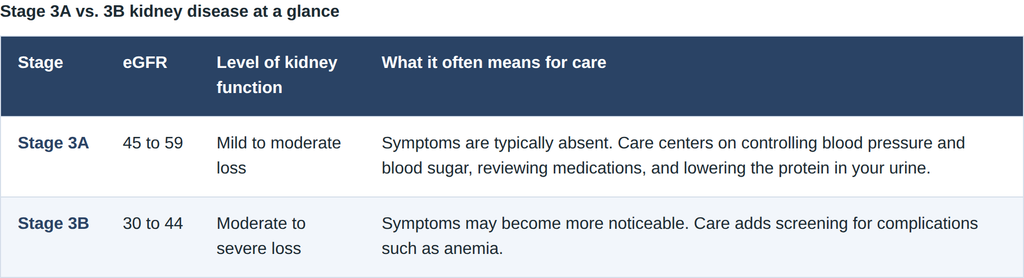
Stage 3 covers a wide range of kidney function, so doctors divide it into two substages based on your eGFR. Stage 3A is a mild to moderate loss of kidney function, and stage 3B is a moderate to severe loss. Both count as stage 3 chronic kidney disease. Here is how they compare.
Stage 3A (eGFR 45 to 59)
Stage 3A kidney disease means your eGFR has stayed between 45 and 59 for at least three months. Most people with CKD stage 3A have no symptoms. Care at this point centers on protecting the function you have: controlling blood pressure and blood sugar, reviewing your medications, and lowering the protein in your urine, since keeping your urine uACR as low as possible helps protect both your kidneys and your heart.
Stage 3B (eGFR 30 to 44)
Stage 3B kidney disease means your eGFR has stayed between 30 and 44 for at least three months. Symptoms may start to become more noticeable at this point, including tiredness, trouble concentrating, swelling, shortness of breath, nausea, and loss of appetite. Complications can also begin to develop, such as anemia (low red blood cells), mineral and bone disorder (calcium and phosphorus out of balance), and acid buildup in the blood. The National Kidney Foundation notes that the risk of these complications at CKD stage 3B is low, and it still recommends screening with simple blood tests. Not everyone with stage 3B will develop kidney failure.
Why One Number Is Only Part of the Picture
Your eGFR can vary with hydration, illness, and medications, so doctors confirm your stage with repeat testing over at least three months. Treating a reversible cause may bring your numbers back to normal or close to it. Your uACR adds a second layer, since your stage and risk are based on both numbers. To see how each stage is defined, start with our guide to all five stages.
Stage 3 Kidney Disease Symptoms
Many people with stage 3 kidney disease have no symptoms at all. Blood and urine tests are how stage 3 is found.
When stage 3 kidney disease symptoms do appear, NKF says they may start to become more noticeable at stage 3B. The signs to watch for include:
- Fatigue and low energy, sometimes with trouble concentrating
- Swelling in your legs, ankles, and feet, or puffiness around your eyes in the morning
- Foamy urine, or needing to urinate more often, especially at night
- Trouble sleeping or muscle cramps at night
- Dry, itchy skin
- Poor appetite
The CDC notes that blood and urine tests are the only way to find out for sure if you have CKD. A blood test for eGFR and a urine test for uACR show how your kidneys are doing. Our guide to the five tests for kidney disease explains what each one measures.
If you have any concerns about your kidney function, ask your doctor, and contact our office for further explanation. Our guide to when swelling in your legs and ankles is a reason to worry explains what to look for.
Outlook With Stage 3 Kidney Disease
What Is the Life Expectancy for Stage 3 Kidney Disease?
Research on stage 3 kidney disease points to a low risk of kidney failure and a higher risk of heart problems. A systematic review of 13 studies in the British Journal of General Practice found that the risk of progressing to kidney failure in stage 3 was low, while the risk of cardiovascular disease was higher than in people without CKD. The National Kidney Foundation also notes that not everyone with stage 3B will develop kidney failure, and that people with stage 3B are at high risk for heart disease.
Several factors shape your outlook:
- Your age. The same review found that the added risk of death from a lower eGFR shrinks as age increases.
- Protein in your urine. A higher uACR means more protein is leaking into your urine, and lowering it helps protect both your kidneys and your heart.
- Blood pressure and blood sugar. Keeping both in your target ranges helps protect your kidneys.
- Your heart health. The review found a higher risk of cardiovascular disease in stage 3, so protecting your heart matters.
- Smoking and daily habits. Quitting smoking can slow kidney damage, and physical activity and certain eating habits also help.
- Your substage. Risk is generally higher at stage 3B than at stage 3A.
Ask your care team what your numbers mean for you.
Can Stage 3 Kidney Disease Be Reversed?
Stage 3 kidney disease usually cannot be reversed, because chronic kidney damage is permanent. Taking steps now can help slow down or even stop your CKD from getting worse, which is the goal of treatment at this stage. Your nephrologist may also recommend kidney-protecting medicines, such as ACE inhibitors, ARBs, or SGLT2 inhibitors, alongside blood pressure and blood sugar control.
There is one important exception. Sudden changes in kidney function, known as acute kidney injury, may be temporary and reversible. The National Kidney Foundation lists dehydration, infection, and a medication reaction as examples of causes that treatment can address. Taking certain medications can also lower your eGFR without long-term kidney damage, and over-the-counter NSAIDs can harm your kidneys if taken at high doses or used too often. That is why a single low number deserves a repeat test, and why your care team looks at your results over time. For a deeper look at what can and cannot be undone, read our guide, Can You Reverse Kidney Damage?
How to Protect Your Kidneys at Stage 3
The goal of CKD stage 3 care is to protect the kidney function you have for as long as possible. Most of the work comes down to a few steps you and your care team can start on now:
- Control your blood pressure. Keeping it in your target range helps protect your kidneys, and our guide to the blood pressure number that matters more for your kidneys is a good place to start.
- Manage your blood sugar. If you have diabetes, keeping your glucose in range helps your kidneys stay healthy.
- Review your medications. Over-the-counter NSAID pain relievers can be harmful to your kidneys, especially at higher doses or with long-term use, so check with your provider before taking them.
- Stay active and stop smoking. Regular exercise and quitting tobacco both help protect your kidneys and your heart.
How Often Should Stage 3 Kidney Disease Be Monitored?
Monitoring means repeating two labs on a schedule set by your stage and your risk. Your eGFR shows how well your kidneys filter, and your uACR shows how much protein is leaking into your urine, so together they reveal changes early. The National Kidney Foundation’s risk map, for example, suggests testing at least twice a year for stage 3A with moderately increased protein in the urine, and at least three times a year for stage 3B with severely increased protein. Your own schedule may differ, so ask your care team how often you should be tested and keep track of your results over time.
When to See a Nephrologist
Your primary care provider may manage stage 3 kidney disease at first. A referral to a nephrologist is worth asking about when:
- Your eGFR is falling over time
- Your uACR is high, meaning a lot of protein is leaking into your urine
- Your blood pressure stays high even with four or more blood pressure medicines
- You have stage 3B with significant protein in your urine
- Complications such as anemia, mineral and bone problems, or acid buildup in the blood appear
Our guide to knowing when to see a nephrologist walks through the signs in more detail.
Stage 3 Kidney Disease Diet
There is no single stage 3 kidney disease diet that fits everyone. A balanced diet that limits sodium is a sound starting point, because too much sodium can cause fluid buildup, swelling, higher blood pressure, and strain on your heart. Protein, potassium, and phosphorus are more individual. How much you need depends on how well your kidneys are working, your lab results, and your medications. Ask your doctor about meeting with a registered dietitian who has special training in kidney disease. For a starting point on everyday food choices, see our guide to 10 foods to eat or avoid if you have kidney disease.
TL;DR: Quick Answers
What is stage 3 kidney disease?
Stage 3 kidney disease, also called chronic kidney disease stage 3 or CKD stage 3, means your eGFR has stayed between 30 and 59 for three months or more. It is the middle of the five CKD stages and the point where most people are first diagnosed. Many people feel fine, so blood and urine tests are how it is found.
What is the difference between 3A and 3B?
Stage 3A kidney disease means an eGFR of 45 to 59, a mild to moderate loss of function. Stage 3B means an eGFR of 30 to 44, a moderate to severe loss. Symptoms may start to become more noticeable at stage 3B, and complications such as anemia can begin to appear, although NKF notes the risk at this stage is low. Your uACR, which measures protein in your urine, also shapes your care plan at either substage.
Is stage 3 kidney failure?
No. Kidney failure refers to stage 5, when eGFR falls below 15 or a person needs dialysis. Stage 3 is an earlier stage of kidney disease, and the CDC notes that not all people with kidney disease progress to kidney failure. Controlling blood pressure and blood sugar, reviewing medications, and keeping up with lab checks all help protect the function you have.
Can stage 3 kidney disease be reversed?
Stage 3 kidney disease usually cannot be reversed, because chronic kidney damage is permanent. Treatment can slow or even stop CKD from getting worse, though. Sudden drops in kidney function from causes such as dehydration, infection, or a medication reaction may be temporary and treatable, which is why a low eGFR result deserves a repeat test before anyone draws conclusions.
When should I see a nephrologist?
Ask about a referral if your eGFR is falling over time, your uACR is high, your blood pressure stays high even with four or more blood pressure medicines, or you have stage 3B with significant protein in your urine. Anemia, mineral and bone problems, and acid buildup in the blood are also reasons to see a kidney specialist. If anything remains unclear, our Durham and Oxford, NC offices are available to explain.
How Durham Nephrology Associates Supports Stage 3 Care
If you have been diagnosed with stage 3 kidney disease, you do not have to manage it alone. Durham Nephrology Associates has provided comprehensive treatment and management of kidney disease for more than 30 years, and our nephrologists, physician assistants, and nurse practitioners see patients at offices in Durham, South Durham, and Oxford, NC. If you have typed “kidney doctor near me” into a search bar, you can find a nephrologist in Durham and Oxford, NC at our Durham office, our Oxford office, or our South Durham location.
We believe in the importance of good communication, so if anything about your results remains unclear, we encourage you to contact us for further explanation.
Our practice also provides medical direction at seven dialysis centers across Durham and Granville counties. We also help people physically and mentally prepare for the possibility of future dialysis treatments, and we help with long-term dialysis and transplantation needs. Our physicians also care for hospitalized patients at Duke Regional Hospital and Granville Medical Center.
Ready to talk with a nephrologist? Visit our Durham office or our Oxford office, meet our team, or request an appointment, and contact us for further explanation of your stage 3 results and plan what comes next.
Take the Next Step With Your Kidney Health
A stage 3 kidney disease diagnosis can bring a lot of questions, and the good news is that there is plenty you can do. Your eGFR and uACR show where you stand, your stage (3A or 3B) guides how closely you are monitored, and steps like controlling blood pressure and blood sugar, reviewing your medications, and eating with your kidneys in mind can help protect the function you have.
You do not have to wait for symptoms to ask for help, and you do not need to have every question answered before you book. If anything remains unclear, we encourage you to contact us for further explanation. Request an appointment with Durham Nephrology Associates today at one of our offices in Durham, South Durham, or Oxford.
Acting early matters, since the CDC notes that the earlier CKD treatment starts, the better.
Sources
- National Kidney Foundation. Stages of Chronic Kidney Disease (CKD). Page metadata dated August 2026.
- National Kidney Foundation. Stage G3a Chronic Kidney Disease (CKD). Last updated July 17, 2026.
- National Kidney Foundation. Stage G3b Chronic Kidney Disease (CKD). Last updated July 17, 2026.
- National Kidney Foundation. Stage G5 Chronic Kidney Disease (CKD). Last updated July 17, 2026.
- National Kidney Foundation. Kidney Disease Signs & Symptoms. Updated August 12, 2024.
- National Kidney Foundation. Can my GFR get better? Last updated June 1, 2023.
- National Kidney Foundation. Can You Improve Your eGFR? What the Science Says. July 8, 2025.
- National Kidney Foundation. CKD Risk Assessment Tool. 2026.
- National Kidney Foundation. Nutrition and Kidney Disease, Stages 1-5 (Not on Dialysis). Last updated March 18, 2024.
- Centers for Disease Control and Prevention. Chronic Kidney Disease Basics. Last reviewed May 15, 2024.
- Sharma P, McCullough K, Scotland G, et al. Does stage-3 chronic kidney disease matter? A systematic literature review. British Journal of General Practice, 2010;60(575):e266 to e276.
| Stage | eGFR | Level of kidney function | What it often means for care |
|---|---|---|---|
| Stage 3A | 45 to 59 | Mild to moderate loss | Symptoms are typically absent. Care centers on controlling blood pressure and blood sugar, reviewing medications, and lowering the protein in your urine. |
| Stage 3B | 30 to 44 | Moderate to severe loss | Symptoms may become more noticeable. Care adds screening for complications such as anemia. |
